linked list in Data Structure


                     LINKED LIST


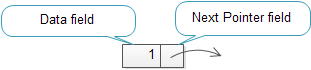
   A linked list is non-premitive data structure. linked list is a way to store a collection of elements. Like an array these can be character or integers. Each element in a linked list is stored in the form of a node. And a node is a collection of two sub-elements or parts , information or data part and another is address part . A linked list is formed when many such nodes are linked together to form a chain. Each node points to the next node present in the order. The first node is always used as a reference to traverse the list and is called Start or head and the last node points to NULL.
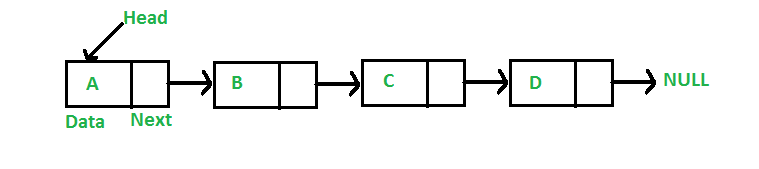
Image result for linked list in c


Linked List - Node

Arrays can be used to store linear data of similar types, but arrays have some limitations as the size of the arrays is fixed: So we must know the upper limit on the number of elements in advance. Also, generally, the allocated memory is equal to the upper limit irrespective of the usage. Inserting a new element in an array of elements is expensive, because room has to be created for the new elements and to create room existing elements have to shifted . Random access is not allowed. We have to access elements sequentially starting from the first node.

 To overcome these limitation of array the concept of linked list is introduced. Following are the basic operations supported by a list.
    
       Insertion − Adds an element at the beginning of the list.
      Deletion − Deletes an element at the beginning of the list.
      Display − Displays the complete list.
      Search −  Searches an element using the given key.
      Delete −  Deletes an element using the given key.
    Traverse - Move from first node to desired node.

There are three common types of Linked List :-
Singly Linked list.
Doubly Linked list.
Circular Linked list.
Singly linked list is commonly used linked list , which is well explained above. Now we can traverse forward in singly linked list but sometimes it is required to travel the list in either the direction which is possible in singly linked list. To overcome this limitation of singly linked list ,doubly linked list is introduced. This type of list uses two pointers for predecessor and successor of each node.the link denoting the predecessor is called 'left link' and that denotes the successor is called 'right link' . 
Image result for doubly linked list
Hence a node have three fields. Out of which one is information field and two are address fields of previous and next node. So we use two pointer variables and one normal variable.
Image result for doubly linked list


Now Circular linked list is a linked list where all nodes are connected to form a circle. There is no NULL at the end. A circular linked list can be a singly circular linked list or doubly circular linked list. Any node can be a starting point. We can traverse the whole list by starting from any point. We don’t need to maintain two pointers for front and rear if we use circular linked list. We can maintain a pointer to the last inserted node and front can always be obtained as next of last. 


Comments

Post a Comment

Please comment.

Popular posts from this blog

Process Scheduling And Types of Process Schedular :-

        ⇰ PROCESS SCHEDULING Process Scheduling  is a task  of Operating System that schedules processes of different states like new, ready, waiting, terminated  and running.This scheduling helps in allocation of CPU time for each process, and Operating System allocates the CPU time for each procss. And the process scheduling plays important role to keep the CPU busy all the time.  ⏩   Followings are some objectives of Process Scheduling :-  i > To increase the amount of users within acceptable response times.  ii > To maintain the balance between response and utilization of system. iii > To decrease the enforce priorities and  give reference to the processes holding the key resources.      ⇰  PROCESS SCHEDULAR A scheduler carries out the pro cess scheduling work. Schedulers are often implemented so they keep all computer resources busy and  allows multiple users to shar...

Process & Its state And process control block :-

                ⇰  PROCESS :- A process can be thought of as a program in execution. Means when any program is executed it becomes process. A processwill need certain resources such as CPU time , memory, files and I/O devices to complete its task. These resources are allocated to the process either when it is created or at the time of execution.             A process is the unit of work in most systems. A system consistes of a collection of processes. All these processes may execute concurrently. Traditionally a process contained only a single thread. Most modern operating ststems now supports processes that have multiple threads.         The operating system is responsible for several important works of process management as - the creation and deletion of process, the schrduling of process, communication and deadlock handling of process. Process is broudly divided into two ...

Logical VS Physical Address Space In Operating System

Basically an address generated by the CPU is commonly referred  as a logical address, whereas an address seen by the memory unit is commonly referred as a physical address.The compile-time and load-time address-binding methods generate identical logical and physical addresses. However, the execution-time address binding scheme results in differing logical and physical addresses. In this case, we usually refer to the logical address as a virtual address. The set of all logical addresses generated by a program is a logical address space. The set of all physical addresses corresponding to these logical addresses is a physical address space. Thus, in the execution-time address-binding scheme, the logical and physical address spaces differ. The run-time mapping from virtual to physical addresses is done by a hardware device called the memory-management unit (MMU). The user program generates only logical addresses and thinks tha...